Showing posts with label Stuff. Show all posts

July 16, 2025

A year of adventures

This isn't one of my usual project blog posts, but I owe my dear readers some context for the lack of project content.

The last year did not go like I expected.

Part 1: I ride my bike a lot

In mid May last year my friend Sam and I decided to ride the Great Divide Mountain Bike Route, a mostly off-road route from Banff, AB to the Mexico border in Antelope Wells, NM.  We'd been talking about it for years (I first learned about the route in 2014 from Shane Wighton, who had raced the Tour Divide, when Sam and I were interns at Formlabs), and the opportunity finally arose, between Sam switching jobs and me having accumulated a boat load of PTO over the last 5 years.

The decision was fairly last-minute as things like this go.  Mid-May through July was consumed with planning, getting gear, building up a bike, riding my bike even more than usual, and also building some cool robot grippers.

Here's a view of the route, down the Rockies through Alberta, British Columbia, Montana, Idaho, Wyoming, Colorado, and New Mexico.  We did the Tour Divide race route (rather than the ACA version of the GDMBR), which has some "fun" alternates that most people touring the route seemed to avoid.

Here's the bike & setup, and how I stored all the stuff on my bike.  If I did it again I would absolutely use a suspension fork.  The Cutthroat can take a 100mm travel fork, and I thought about getting one, but figured "I've seen all these pictures of people doing it without suspension, it'll be fine, right?".  No, it was not fine.  Sam, meanwhile, rode it on my old full suspension 2014 Santa Cruz Tallboy LT.  Definitely not your typical Divide bike, but it made it  - with many creaks and a seized on cassette - but it made it.

The bike:  2019 Salsa Cutthroat frame bought used, Hunt XC Race wheels, Redshift suspension stem (came with the frame), GRX 1x12 groupset, 2.35" Vittoria Mezcal tires.

The setup

It was amazing, and there were some really hard days.  

Here are some roughly chronological pictures
Spray Lake, on the first day


Lugging my bike up the scree field that is Koko Claims pass.  My upper body was not prepared for this:


Holland Lake, MT


Ascending Fleecer Ridge

And hiking down Fleecer Ridge once it got too steep

Montana is sometimes a desert


Idaho - the route only hits a little corner of the state


Jackson Lake, WY


Old mine just before Atlantic City, WY

The Great Divide Basin, where we got blasted by brutal headwinds for ~200 miles until we hit Colorado

Sleeping by the side of the road half way up a pass in CO.  It's hard to get out of Brush Mountain Lodge early in the morning when Kirsten makes is making you pancakes


Descending toward Steamboat Springs


Nice welcome before Steamboat Springs, CO.  Apparently the local farmers hate the Steamboat gravel race

A steep, loose climb towards Salida, CO
View during the incredible descent to Salida

Deer in the aspen
Descending Carnero Pass towards Del Norte

Ran into Joe, another mechanical engineer from Boston, and rode with him through a hailstorm to Del Norte, CO


Leaving Platoro, CO

A rocky and exposed section of CDT in New Mexico.  Should have taken more pictures, the view was amazing but it was brutal to ride on a loaded bike

Leaving Abiquiu, NM, beginning one of the longest climbs of the trip.


Cool rocks on the long road stretch to Grants, NM


Long stretch of road from Cuba and Grants, NM

Pie Town to Silver City

More slow-rolling CDT out of Hachita, NM, ~40mi to the border.  The road disappeared and it turned into winding through cacti and other pointy plants

At the Mexico border!

I tried to record many of the descents on a GoPro - here's one hour (out of many) of riding down mountains:


We finished the trip in 33 days, not taking it easy by any means, but there were some short days when we had to bike repairs done (Sam did a rocky descent before Pinedale in the dark with no rear brake) or really wanted to hit a town and sleep in a real bed.  The typical touring speed seems to be a fair bit slower, judging by the dots surrounding us on Trackleaders and the number of people we passed, and the record is a mind-boggling 11 days, 19 hours, set during the race this year.

Mechanically my only casualty was one derailleur hanger (I brought a spare), otherwise everything worked great.  We did get super lucky with weather and had almost no rain and no scorching temperatures - minimal rain and mud definitely kept the drivetrain alive, I've heard stories about needing to replace chains and cassettes half way through when it's wet and muddy.  Every evening I wiped down my chain and lubed with Silca Synergetic (one of the the best non-wax chain lubes around), and by the end I was only 2/3 the way through the allowable chain wear.

I got no flat tires the entire trip. When I got home I pulled many thorns out of the tires, but the sealant did its job.


Would I do it again?  Maybe - I'd definitely do another ride like this again somewhere else, but watching the race play out this year got me thinking about going back.

Some stats according to the logs:
Miles: 2,722.68
Elevation Gain: 178,717 ft
33 Days:  82.5 mi/day, 5415 ft/day
Average moving speed: 9.58 mph
Average hours “out” per day: 11:12 
Average moving hours per day: 8:36
Top speed: 48 mph

Part 2: you don't need a shoulder anymore

The last couple days of the Divide my shoulder started bothering me.  One day it hurt while riding, but it was a flat day with lots of tarmac, so I could hunch over in the aero bars and ignore it.  The night after we finished, I couldn't sleep from the pain.  And it continued for almost a month - hurting but tolerable during the day, and the worst continual pain I've ever experienced at night.  

A nearly sleepless month, a x-ray, MRI, and EMG/ECG and some physical therapy later, I finally got a diagnosis - Parsonage Turner Syndrome - mysterious damage to the brachial plexus nerves.  It's not really clear what causes it, other than that some risk factors include getting a viral infection (which I'm pretty sure I did not), and "strenuous exercise" (which I certainly did).   Lack of nerve signal feeding the deltoid caused it to almost completely atrophy, and if I tried to raise my arm to the side, nothing at all happened.

that's not supposed to look like that....

After 8 months it finally started showing signs of life, and a year later I have maybe 1/2 of the deltoid again and can raise my arm. 

Part 3:  I moved to California
Just the TL:DR version: I left the Boston area after 13 years, moved out to the Bay Area, and am working on robots with the awesome folk at Physical Intelligence.  The shop came out here with me, fortunately now in a single-car garage, not in a spare bedroom.  

After an eventful year with the least personal project progress I've ever had since I went to college, I'm finally back in action.  More kart updates and other new stuff coming. 


April 19, 2022

Clausing 4901 Moving and Restoration

 I've been keeping my eye out on craiglist and machinery auctions for a small (but not that small) lathe for a while now, but small lathes (other than import mini-lathes) are pretty uncommon.  Someone Austin knows just bought a house just a few miles away from me with this Clausing 4900-series lathe in the basement, so we visited to take a look:


The scale of this lathe really didn't come across in photographs - it's way smaller than I originally thought from the pictures.  MITERS has a Clausing lathe of the same era, a 6918, which looks almost exactly the same but scaled up around 50% in every direction - from the original pictures I saw, I was expecting something more like the MITERS-lathe. 

I took some measurements, determined it would be possible to fit in my apartment, checked out the joist situation supporting the floor where the lathe would sit, and decided to go for it.  

For for the move, I recruited Rob and Andrew, who have moved many tons of machine tools over the last several years (probably all of which are much heavier than the 800-ish pounds this lathe is), plus Austin, Aaron, and myself.

We started by splitting the lathe off its base, to make it less top-heavy.  The lathe and chip tray were un-screwed from the two legs and lifted up with an engine hoist.  We removed the legs and slid Rob's heavy-duty dolly underneath.  


The basement the lathe was in had a door directly outside (so we didn't have to go up any stairs), but the door was pretty far from where we could get a pickup truck.  A dumpster blocked most of the driveway, so we had to haul the lathe up a small hill and around the dumpster.  The dolly rolled surprisingly well over the dirt and grass, even with ~600 lbs on it:


Lifted up again, dolly and all, ready for the truck to be backed under it:


Loaded up and strapped down in the Sliski-mobile.  The 8' truck bed makes the lathe look even smaller:


Getting the lathe into my place was a little tricky since there wasn't a lot of space to maneuver, but it went smoothly.

Here we are going through the front door.  We hand-lifted the lathe up the two steps.  A couple feet inside the front door there was an area of floor we had to avoid, where there's a trapdoor to our water heater.  There aren't joists spanning that section of floor, so we skirted around it.


The dolly just barely fit through the internal doorways, once the doors were removed from the hinges:


To re-assemble the lathe, we again lifted it with the engine hoist and re-attached the legs while the hoist was supporting the weight.  I put a couple 2x6's under the lathe's leveling feet, with big felt pads underneath, to spread the load and protect the floor.


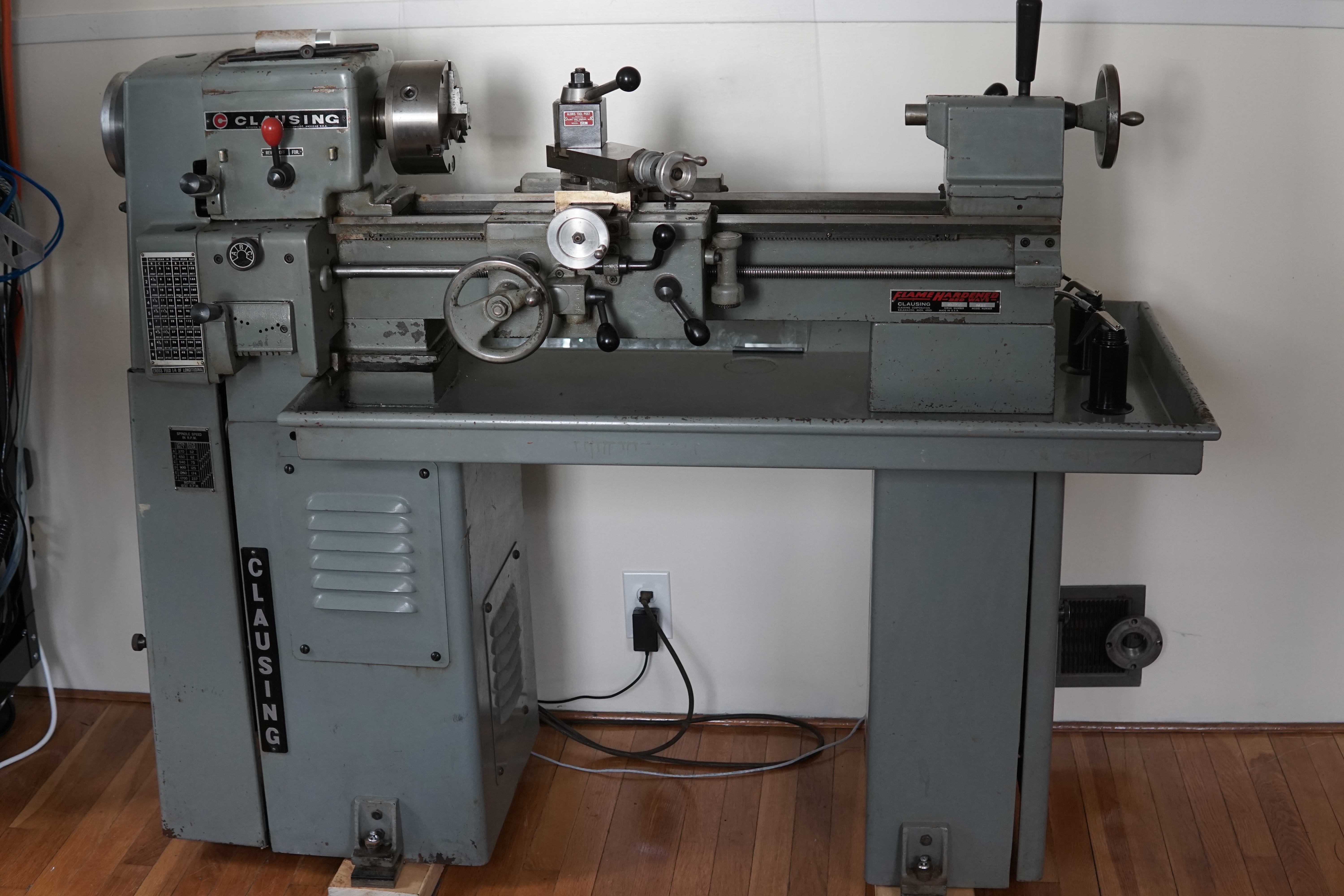
The lathe back on it's stand, in all it's grungy glory:


Initially the headstock was full of paper and cloth scraps - some mice had made a home there.  Fortunately the mice were long gone, and thankfully hadn't left behind any mummified remains.  After vacuuming out all the detritus, here's what the inside of the headstock looked like:


The gears looked pretty rusty, the lever for engaging the back gear was stuck, and the spindle wouldn't turn once the power feed was engaged.  I worked things free by liberally spraying all the gears and shafts down with WD40 and gradually working the spindle back and forth by hand with the power feed gears engaged.  Eventually all the sticky spots in the gearing smoothed out, and the power feed and back gear shifted smoothly:


At first I thought I'd have to take the headstock apart to clean the rust off the gearing, but I was able to do it in-place with a small wire brush.  The state of the gears in the headstock also made me worried about the spindle bearings.  I oiled the spindle bearings and ran the spindle, and the oil that leaked out from the spindle was clean - so I'm assuming the spindle bearings aren't full of rust.

Scrubbed feed gears:


Scrubbed headstock gears:


Gears cleaned, power feed gears greased with some molybdenum disulphide grease, and a fresh timing belt installed - the original was damaged trying to remove it during the move.


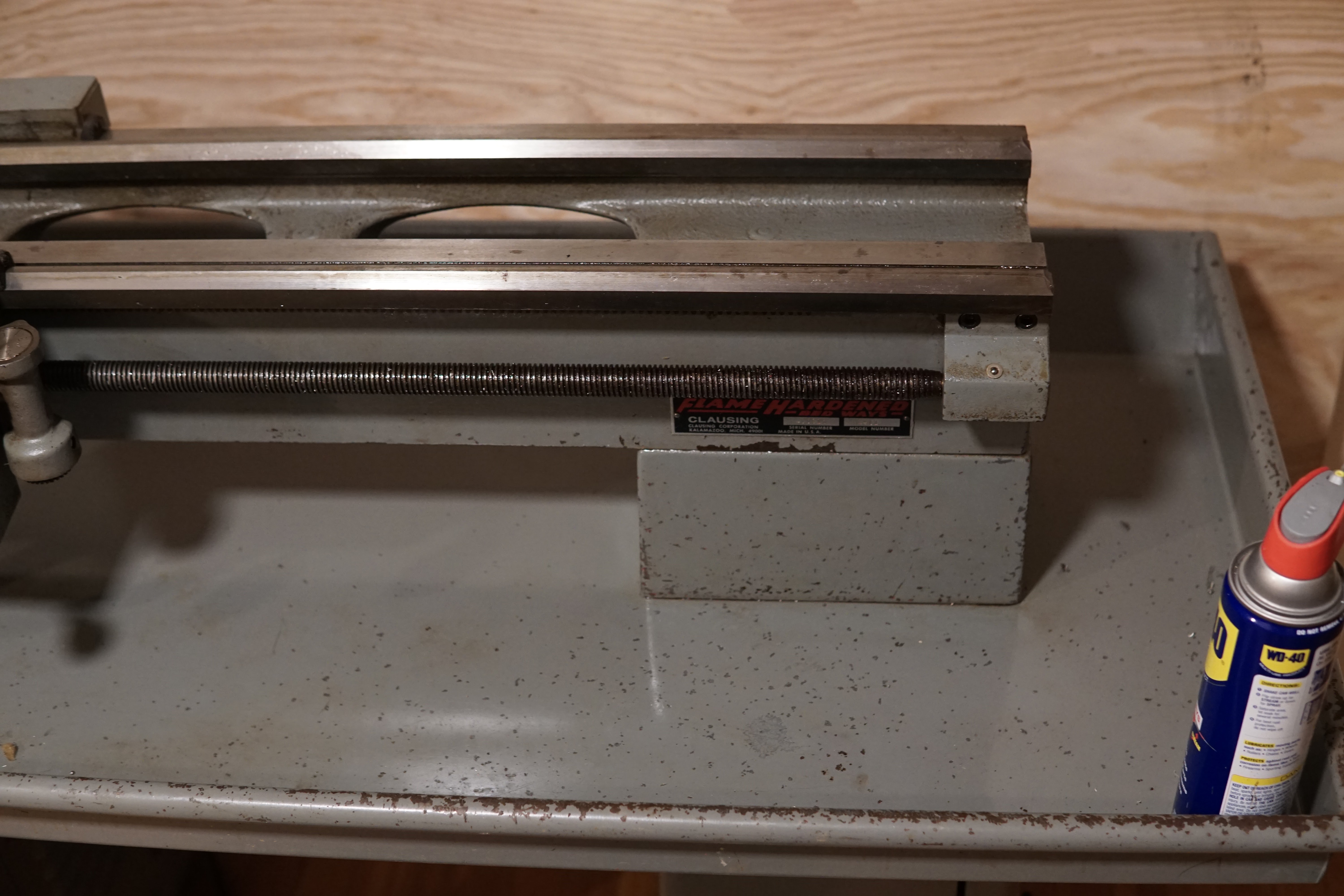
I cleaned the decades of gunk off the painted surfaces by spraying them down with WD40, scrubbing with a plastic-bristled brush, and wiping away the sludge.

Here's the chip pan mid-scrubbing:


Hard to believe this was hiding underneath all the dirt and oil:


I took the cross slide off, and the sliding surfaces look like they're in great condition.  The original grinding marks are still visible across the whole underside of the cross slide, and the lead screw nut has very little backlash.  Also encouraging, the cross slide doesn't tighten up at the extremes of its travel, which would have been a symptom of worn ways.


Here it is all scrubbed with the covers back on.  Looking pretty good, I think:


The lathe came with some great accessories, including the change gears for metric threading.  Most of the accessories had surface rust, but cleaned up really well with some Evaporust.

Before:


After:


8" 4-jaw chuck post-cleaning:


The lathe also came with the original paper manual, factory inspection report, and accessory manuals:


The manual is full of beautiful hand-drawn exploded view like these:


There were some other good bits of history in the manual.  The metric threading gears apparently cost $150 in ~1970 (~$1000 in today's dollars).  Unfortunately the micro carriage stop listed isn't around any more.


Eventually I'll get the manual properly scanned and post it online.  I was able to find the operator manual online already, but not the exploded views, parts lists, and accessory manuals, so someone else might find those useful.

Here it is running and taking it's first cuts out of some scrap aluminum:


The lathe is fully operational now, but I am planning on a few immediate upgrades like adding a digital readout.  All the lathes I've used have been communal (and most of them haven't even had a DRO).  I'm excited for the opportunity to set up a proper tool library with tool offsets stored on the DRO, and no one but me to mess them up.  That should make work way more efficient.  Along with the DRO I'll likely make a solid tool post mount to replace the compound slide, a-la-Renzetti.

The 3/4 HP single-phase AC motor and v-belt system might get swapped for something a little more powerful eventually (should be able to get around 3X the power out of a typical outlet), and electronic speed control would be a big improvement over shifting v-belts around.